Scan our QR code to stay updated with the recent news and upcoming events.
Scan our QR code to stay updated with the recent news and upcoming events.

Gu Benchi (b. 1979, Jiading, Shanghai) is a Shanghai-based Chinese contemporary artist working across abstract painting, sculpture, and installation. Since 2008, he has exhibited extensively throughout mainland China, Hong Kong, Taiwan, Moscow, and Greece, with three solo exhibitions and over fifty group and duo presentations to date. His practice is rooted in a sustained investigation of line, light, time, and materiality, navigating the tension between order and emergence, rationality and sensibility. He has participated in numerous international exchange programs, including projects between China and South Korea, China and Russia, and across the Taiwan Strait, and was selected for the 12th National Exhibition of Fine Arts (The National Art Museum of China, 2014). His works are held in the collections of The National Art Museum of China, the Copelouzos Family Art Museum (Greece), Di Yuan Art Gallery (Jiaxing), Zhi Art Museum (Songyang), and other institutional and corporate collections.
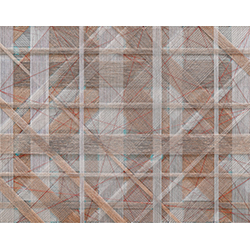
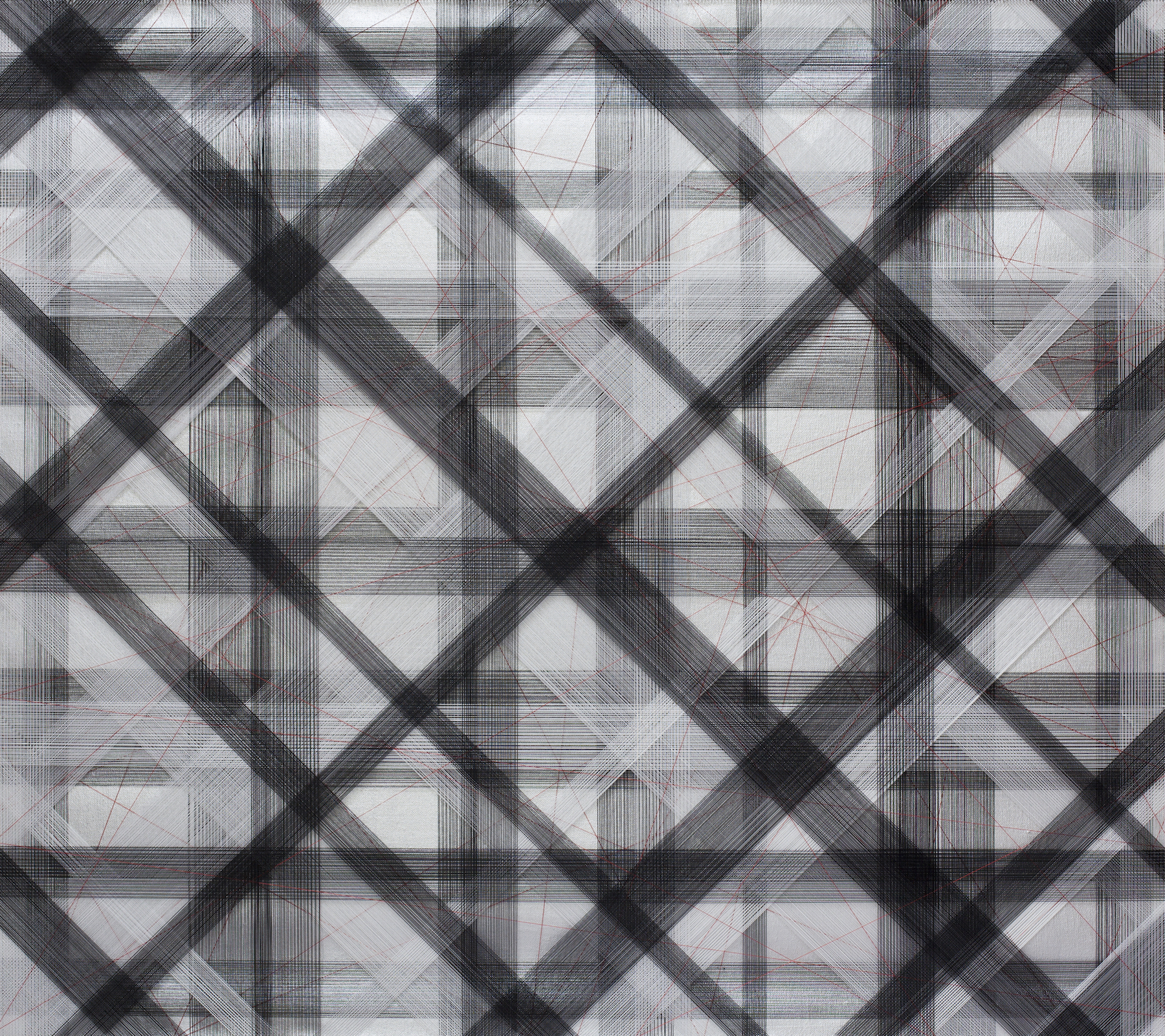
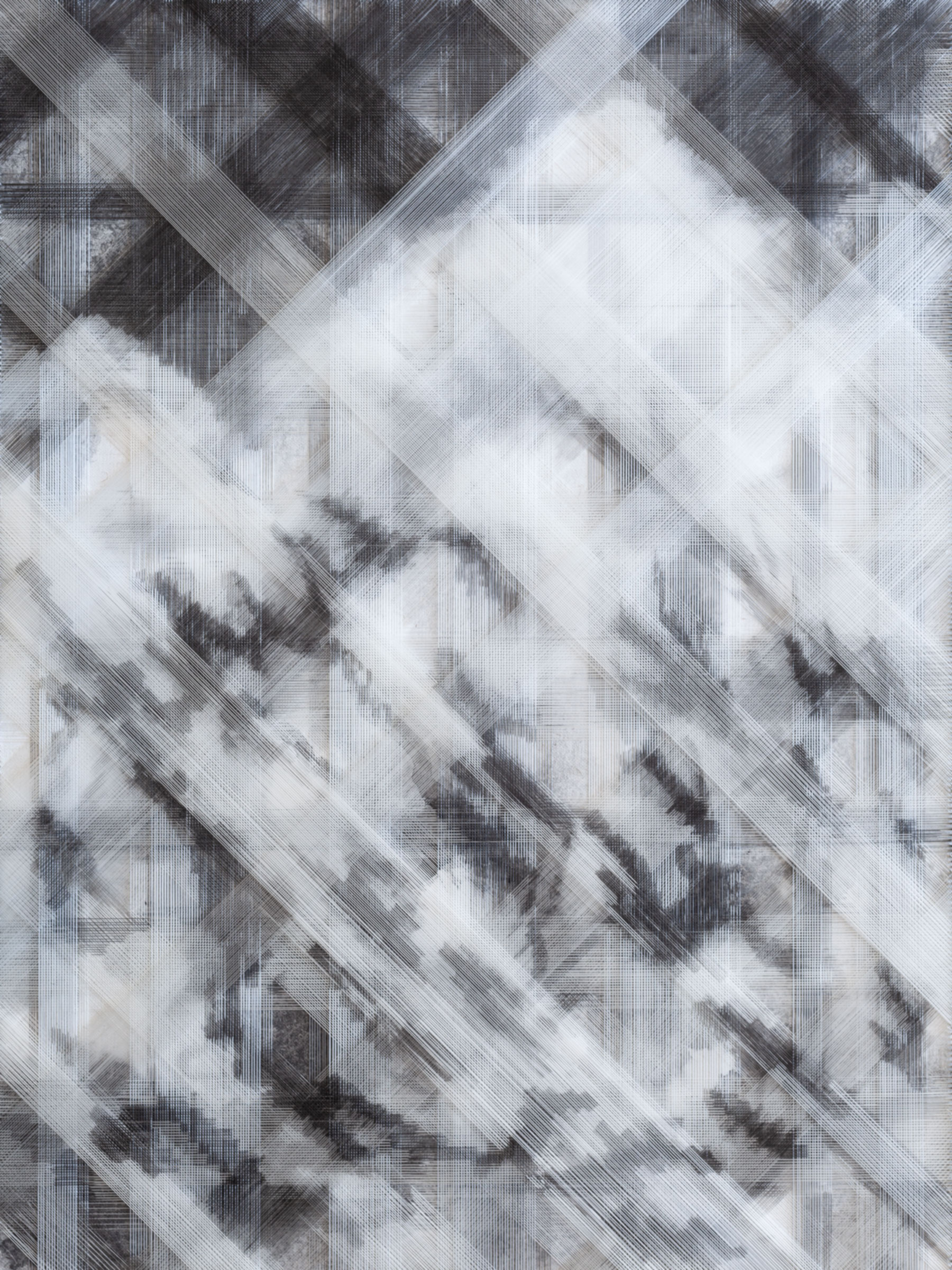
Working primarily with high-strength polyester thread, Gu creates multi-layered woven compositions that span geometric abstraction and, more recently, fragmented portraiture. Rooted in the formal logic of Piet Mondrian, the cosmological structures of Buddhist mandalas, and the architectural ornament of traditional Chinese temple ceilings, his practice transforms the slow, repetitive act of weaving into a meditation on order, consciousness, and the conditions of contemporary selfhood.
Gu Benchi's woven works are built through a process of continuous layering and repetition. Each piece is constructed from superimposed strata of polyester thread, a synthetic material chosen for its stable performance and tensile strength over softer natural fibers or more rigid steel wire. The result is a body of work in which material precision and spiritual inquiry are inseparable: the act of threading, accumulating, and overlapping becomes, in the artist's words, a way of allowing "scattered energy to eventually concentrate and erupt."
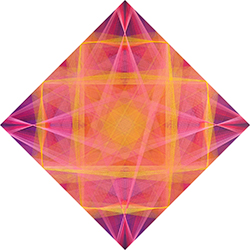
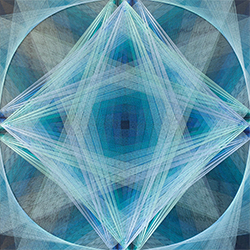
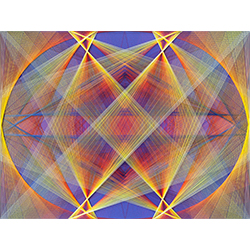
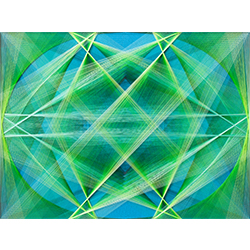
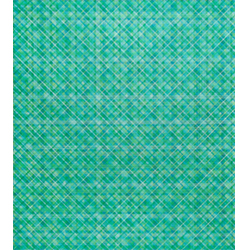
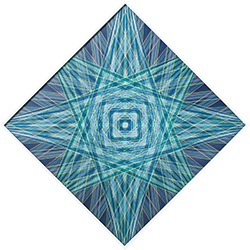
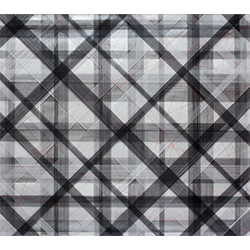
The works divide broadly into two formal registers. The symmetrical compositions are the product of exact mathematical calculation, often assisted by computer software. Once a generative logic is established, functioning, as Gu describes it, like a mathematical formula into which different parameters can be substituted, the artist can freely vary content within a fixed structural framework. Color in these works follows a disciplined scheme, typically seven to eight shades transitioning from dark to light, producing surfaces of graduated luminosity. The grid-based works, by contrast, operate with greater spontaneity. While maintaining the strict spatial order of horizontal and vertical lines, Gu seeks rhythm and cadence through intuitive variations in color, width, and line thickness. He likens this mode to jazz improvisation: "You only need to consider the broad framework, leaving the rest to intuition to freely unfold."
In both registers, the works function as sites of optical complexity. Multi-layered configurations generate shifting perspectival effects as viewing angles and lighting conditions change. The interplay between overlapping strata produces a sense of spatial depth and dimensionality that exceeds the works' physical flatness. Light, which Gu calls "an implicit medium," activates these layers, making distinct segments more or less visible depending on the intensity and direction of illumination. An entire series, titled "Light," is dedicated to this dynamic interplay. For exhibition, Gu favors the atmosphere of a dimly lit theater, spotlights trained only on the works so that they appear "like luminous stars in the night sky", a staging that foregrounds the act of concentrated looking as a prerequisite for the work to fully reveal itself.
The visual and structural vocabulary of these compositions draws from a network of references that connects Western modernism to East Asian spiritual and architectural traditions. Gu first encountered Mondrian's paintings as a teenager, and the Dutch master's conviction that beauty resides in the orchestration of rules and proportional relations left a lasting imprint on his approach to arranging materials and constructing visual rhythm. But this formalist inheritance is interlaced with other, deeper sources. The concentric, radiating structures of Esoteric Buddhist mandala paintings, in which different realms occupy distinct positions yet remain interconnected, representing the order of the cosmos, find a direct echo in Gu's symmetrical weavings. Equally formative is the carved ceiling medallion of an ancient opera stage in Jiading's Huilongtan Park, where intricate bracket sets radiate outward in concentric layers and a small brass mirror at the center returns a blurred image of the viewer. In Gu's work, as in that architectural detail, the contemplation of structure becomes a form of self-reflection.
This meditative dimension is central to the works' meaning. Informed by Buddhist practice, particularly the Diamond Sutra, which Gu has copied by hand annually over many years, the artist conceives of his labor not as expression but as verification: each session at the loom is "a moment to verify whether the mind is tranquil and whether thoughts remain focused." The finished work becomes a mirror, "reflecting a fragment of my own self." In this framework, the repetitive process of weaving is akin to the repetitive practices of Buddhist meditation: both are disciplines of sustained attention that seek clarity through accumulated, patient effort rather than singular, dramatic gesture.
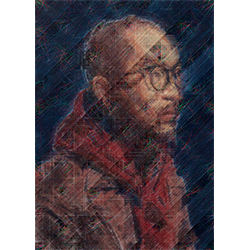
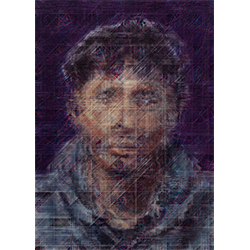
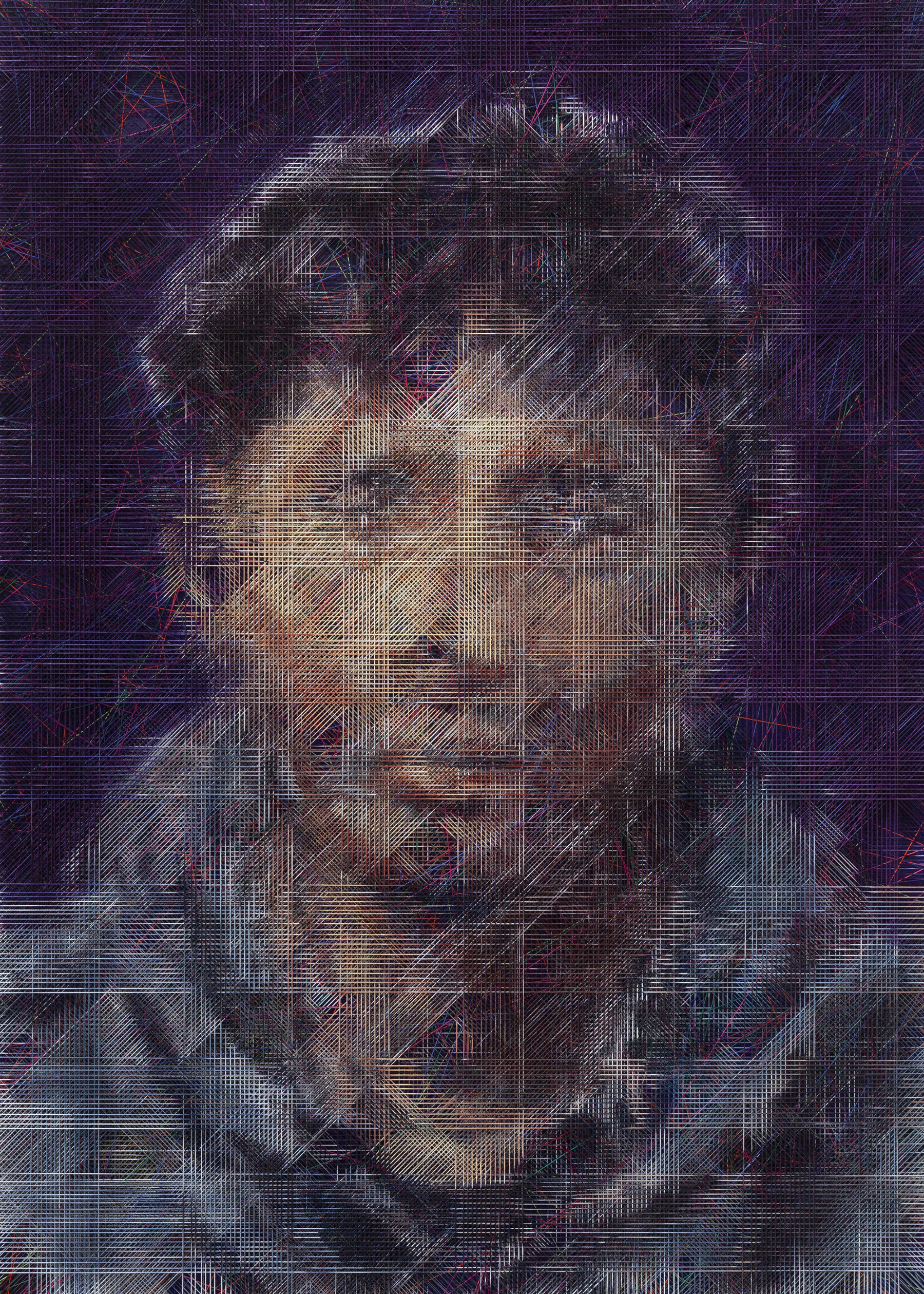
Gu Benchi's most recent series marks a significant evolution. Moving from pure geometric abstraction into portraiture, he applies his technique of multi-layered weaving, now across eight superimposed strata, to the human face. The shift was prompted by what the artist describes as a growing perception, in the aftermath of the global pandemic, of fracture and incommunicability in contemporary life. Citing Herbert Marcuse's One-Dimensional Man, he observes that "the beautiful vision of a global village and universal harmony has vanished like a dream in an instant."
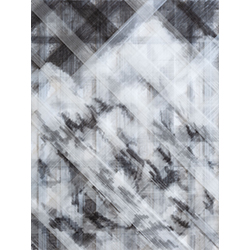
In these portrait works; the woven layers do not resolve into a unified image. Instead, they produce a figure that is simultaneously present and dispersed, fractured across strata, partially visible, partially obscured. The technique gives material form to what Gu identifies as the defining condition of contemporary subjectivity: a self that is no longer whole but has been, in his words, "crushed by this era into rigid fragments." Values, social networks, identity constructs, and information systems all participate in this ongoing fragmentation. The Buddhist term he invokes is "entangled by myriad conditions", a state in which the true self is bound by illusory desires and genuine freedom gradually drifts out of reach.
Yet the portrait works are not exercises in despair. Drawing on the Diamond Sutra's teaching that "all appearances are illusions," Gu reframes portraiture, a genre historically dedicated to capturing individual identity, as a means of expressing "emptiness." In his account, people do not exist as a fixed "self" but are rather "vessels for the world and spirituality." The fragmented portrait, then, does not mourn a lost wholeness. It reveals a truth that was always there: the self as permeable, contingent, constructed.
The artist acknowledges the apparent futility of this project with characteristic lucidity, describing the endeavor as potentially "little more than a footnote to futility." But he counters with a philosophy of dignified endurance drawn from Viktor Frankl, Albert Camus, and the Chinese myth of Jingwei, the bird who carries pebbles, one by one, to fill the sea. Like Camus's Sisyphus, Gu finds meaning not in the resolution of the task but in the refusal to abandon it. "Hope is ignited through persistent perseverance," he writes, "and those who possess hope are undoubtedly happy." Sometimes, while weaving, he imagines Jingwei's delicate wingtips gently touching the string-like threads.
Gu Benchi's works hold together what might otherwise seem irreconcilable: the rigor of mathematical planning and the freedom of intuitive improvisation; the synthetic precision of industrial polyester and the spiritual aspirations of Buddhist contemplation; the austere geometries of Western modernism and the cosmological structures of Eastern religious art. What unites these poles is the discipline of repetition itself, a commitment to slow, embodied labor that refuses the accelerating rhythms of the digital age. In a cultural moment defined by fragmentation, distraction, and the erosion of sustained attention, the works propose an alternative temporality: one measured not in scrolls and clicks, but in the patient accumulation of thread upon thread, layer upon layer, breath upon breath.
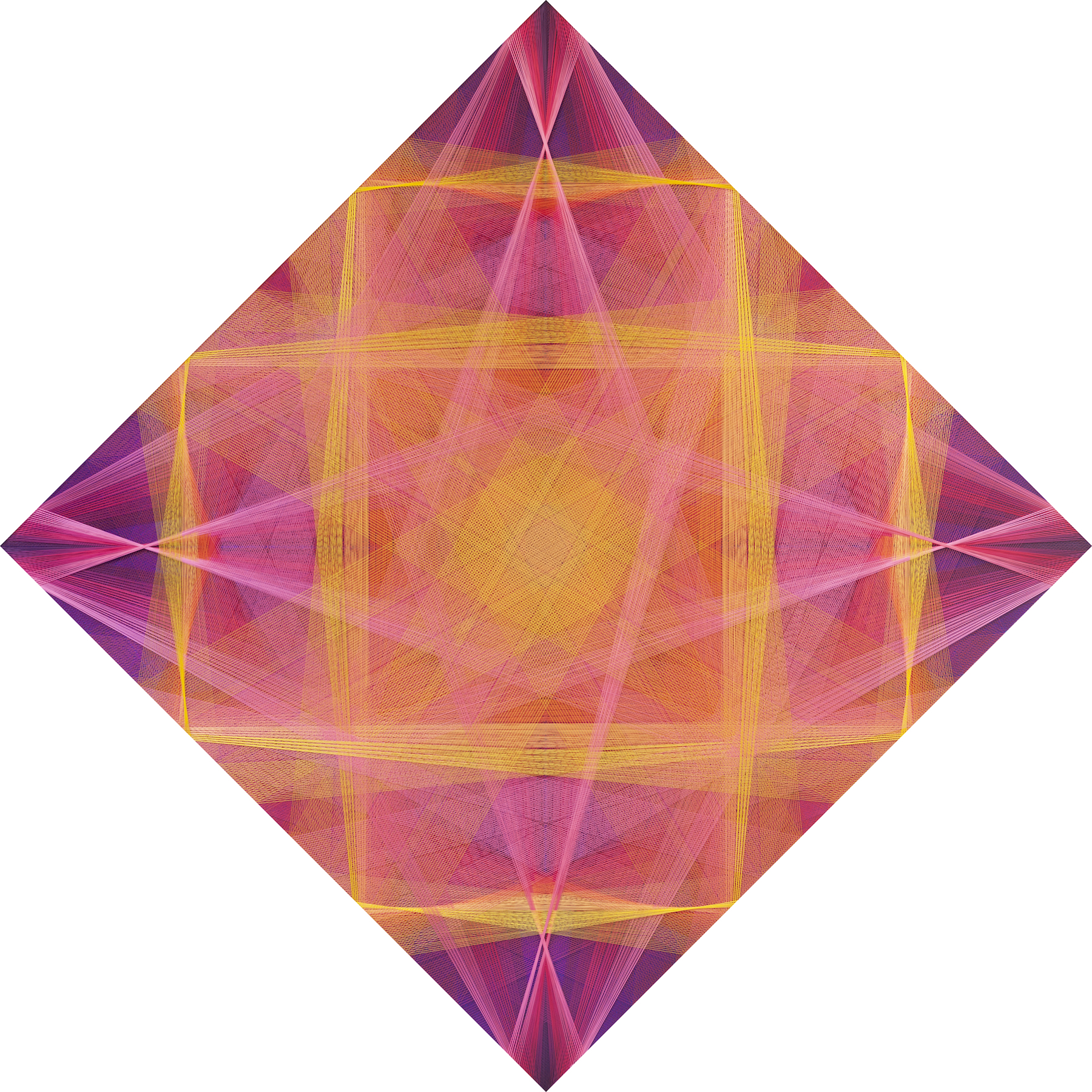
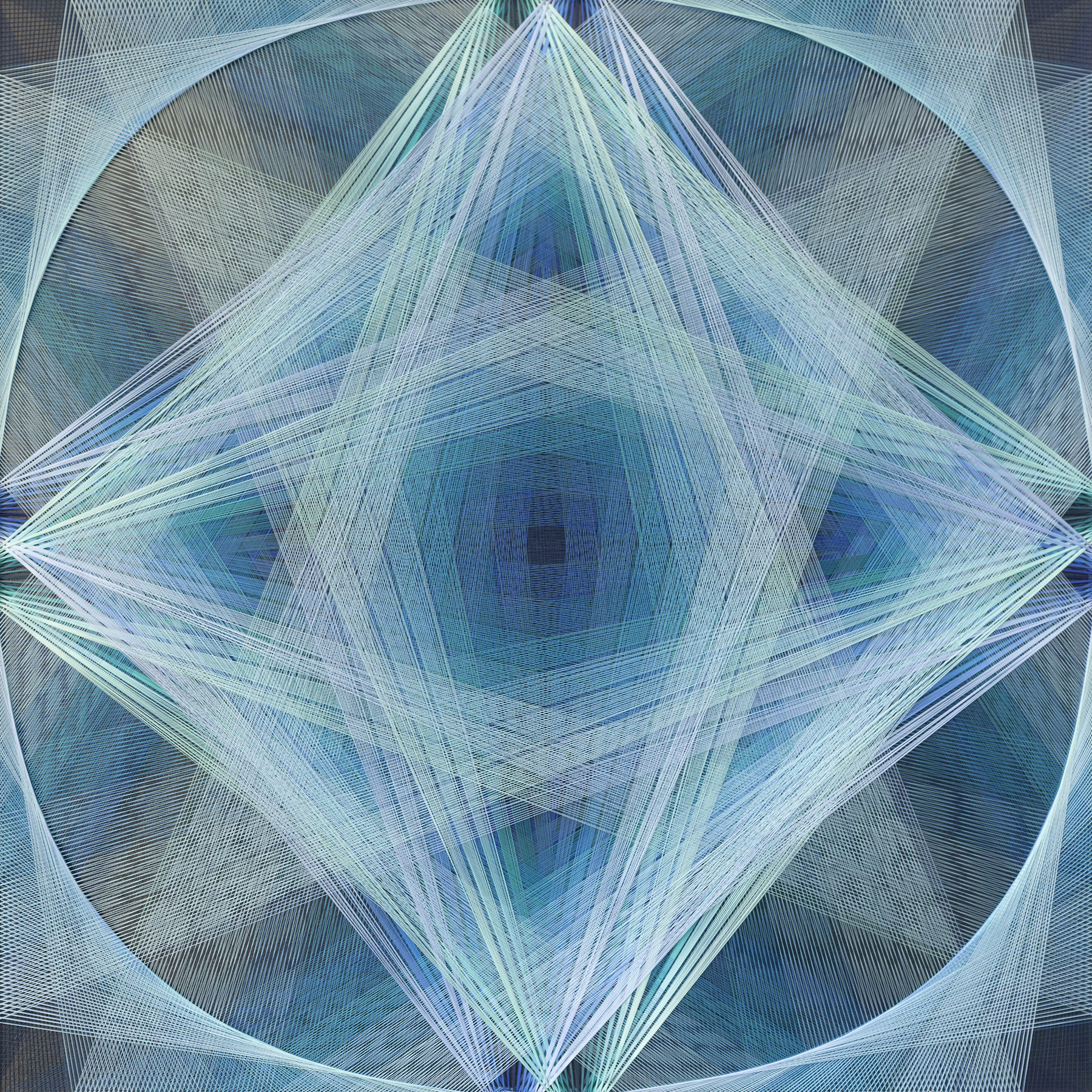

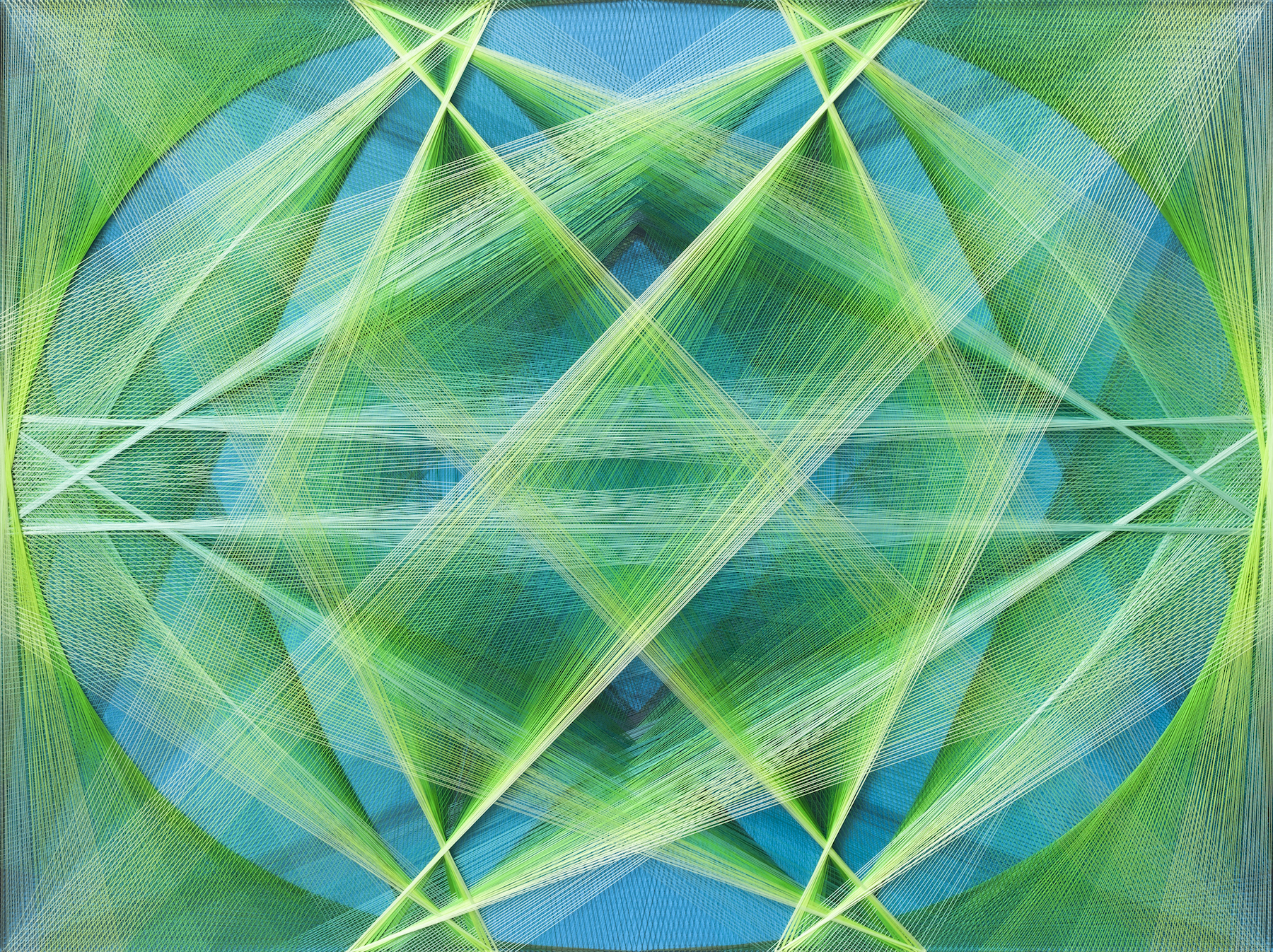

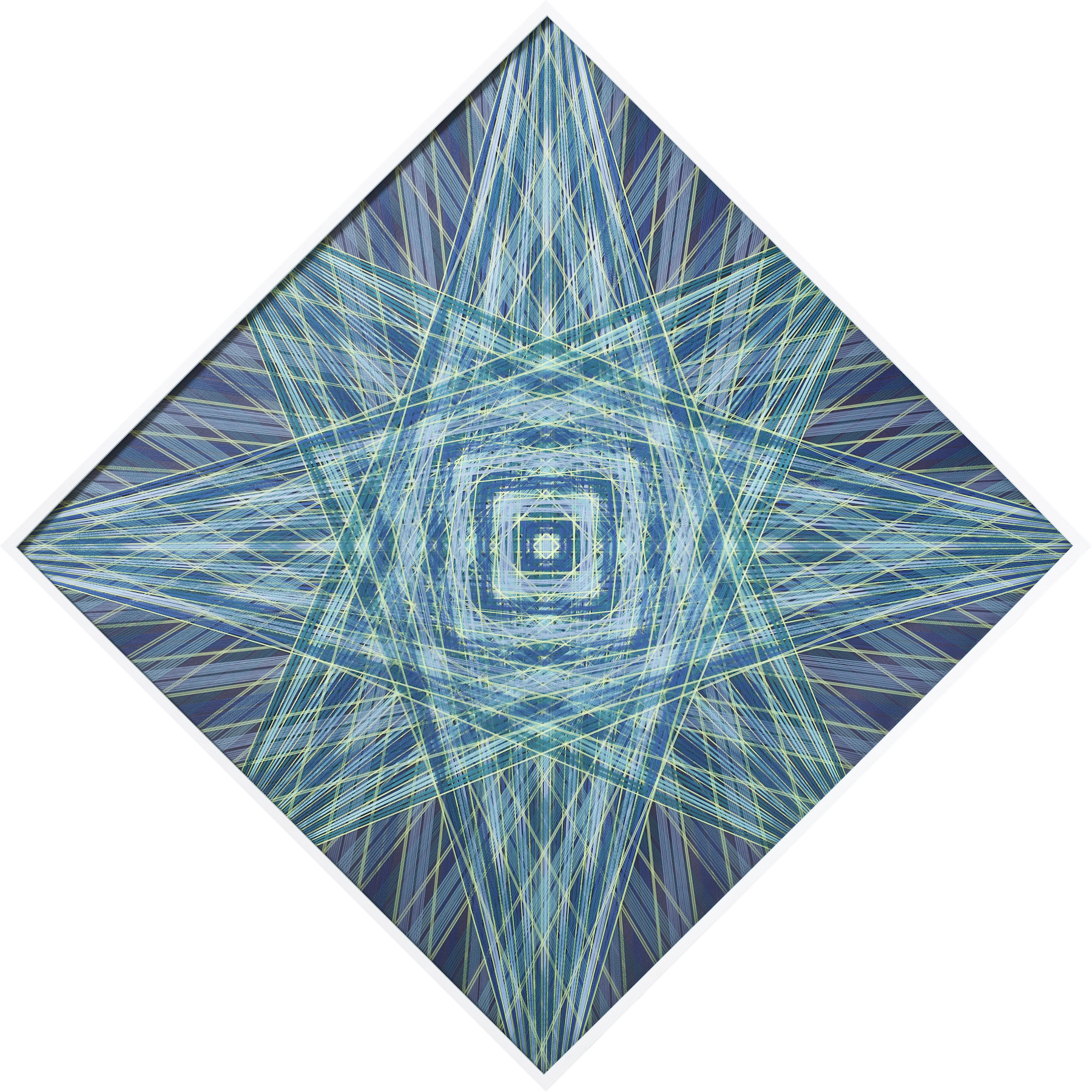


Gu Benchi (b. 1979, Jiading, Shanghai) is a Shanghai-based Chinese contemporary artist working across abstract painting, sculpture, and installation. Since 2008, he has exhibited extensively throughout mainland China, Hong Kong, Taiwan, Moscow, and Greece, with three solo exhibitions and over fifty group and duo presentations to date. His practice is rooted in a sustained investigation of line, light, time, and materiality, navigating the tension between order and emergence, rationality and sensibility. He has participated in numerous international exchange programs, including projects between China and South Korea, China and Russia, and across the Taiwan Strait, and was selected for the 12th National Exhibition of Fine Arts (The National Art Museum of China, 2014). His works are held in the collections of The National Art Museum of China, the Copelouzos Family Art Museum (Greece), Di Yuan Art Gallery (Jiaxing), Zhi Art Museum (Songyang), and other institutional and corporate collections.
Working primarily with high-strength polyester thread, Gu creates multi-layered woven compositions that span geometric abstraction and, more recently, fragmented portraiture. Rooted in the formal logic of Piet Mondrian, the cosmological structures of Buddhist mandalas, and the architectural ornament of traditional Chinese temple ceilings, his practice transforms the slow, repetitive act of weaving into a meditation on order, consciousness, and the conditions of contemporary selfhood.
Gu Benchi's woven works are built through a process of continuous layering and repetition. Each piece is constructed from superimposed strata of polyester thread, a synthetic material chosen for its stable performance and tensile strength over softer natural fibers or more rigid steel wire. The result is a body of work in which material precision and spiritual inquiry are inseparable: the act of threading, accumulating, and overlapping becomes, in the artist's words, a way of allowing "scattered energy to eventually concentrate and erupt."
The works divide broadly into two formal registers. The symmetrical compositions are the product of exact mathematical calculation, often assisted by computer software. Once a generative logic is established, functioning, as Gu describes it, like a mathematical formula into which different parameters can be substituted, the artist can freely vary content within a fixed structural framework. Color in these works follows a disciplined scheme, typically seven to eight shades transitioning from dark to light, producing surfaces of graduated luminosity. The grid-based works, by contrast, operate with greater spontaneity. While maintaining the strict spatial order of horizontal and vertical lines, Gu seeks rhythm and cadence through intuitive variations in color, width, and line thickness. He likens this mode to jazz improvisation: "You only need to consider the broad framework, leaving the rest to intuition to freely unfold."
In both registers, the works function as sites of optical complexity. Multi-layered configurations generate shifting perspectival effects as viewing angles and lighting conditions change. The interplay between overlapping strata produces a sense of spatial depth and dimensionality that exceeds the works' physical flatness. Light, which Gu calls "an implicit medium," activates these layers, making distinct segments more or less visible depending on the intensity and direction of illumination. An entire series, titled "Light," is dedicated to this dynamic interplay. For exhibition, Gu favors the atmosphere of a dimly lit theater, spotlights trained only on the works so that they appear "like luminous stars in the night sky", a staging that foregrounds the act of concentrated looking as a prerequisite for the work to fully reveal itself.
The visual and structural vocabulary of these compositions draws from a network of references that connects Western modernism to East Asian spiritual and architectural traditions. Gu first encountered Mondrian's paintings as a teenager, and the Dutch master's conviction that beauty resides in the orchestration of rules and proportional relations left a lasting imprint on his approach to arranging materials and constructing visual rhythm. But this formalist inheritance is interlaced with other, deeper sources. The concentric, radiating structures of Esoteric Buddhist mandala paintings, in which different realms occupy distinct positions yet remain interconnected, representing the order of the cosmos, find a direct echo in Gu's symmetrical weavings. Equally formative is the carved ceiling medallion of an ancient opera stage in Jiading's Huilongtan Park, where intricate bracket sets radiate outward in concentric layers and a small brass mirror at the center returns a blurred image of the viewer. In Gu's work, as in that architectural detail, the contemplation of structure becomes a form of self-reflection.
This meditative dimension is central to the works' meaning. Informed by Buddhist practice, particularly the Diamond Sutra, which Gu has copied by hand annually over many years, the artist conceives of his labor not as expression but as verification: each session at the loom is "a moment to verify whether the mind is tranquil and whether thoughts remain focused." The finished work becomes a mirror, "reflecting a fragment of my own self." In this framework, the repetitive process of weaving is akin to the repetitive practices of Buddhist meditation: both are disciplines of sustained attention that seek clarity through accumulated, patient effort rather than singular, dramatic gesture.
Gu Benchi's most recent series marks a significant evolution. Moving from pure geometric abstraction into portraiture, he applies his technique of multi-layered weaving, now across eight superimposed strata, to the human face. The shift was prompted by what the artist describes as a growing perception, in the aftermath of the global pandemic, of fracture and incommunicability in contemporary life. Citing Herbert Marcuse's One-Dimensional Man, he observes that "the beautiful vision of a global village and universal harmony has vanished like a dream in an instant."
In these portrait works; the woven layers do not resolve into a unified image. Instead, they produce a figure that is simultaneously present and dispersed, fractured across strata, partially visible, partially obscured. The technique gives material form to what Gu identifies as the defining condition of contemporary subjectivity: a self that is no longer whole but has been, in his words, "crushed by this era into rigid fragments." Values, social networks, identity constructs, and information systems all participate in this ongoing fragmentation. The Buddhist term he invokes is "entangled by myriad conditions", a state in which the true self is bound by illusory desires and genuine freedom gradually drifts out of reach.
Yet the portrait works are not exercises in despair. Drawing on the Diamond Sutra's teaching that "all appearances are illusions," Gu reframes portraiture, a genre historically dedicated to capturing individual identity, as a means of expressing "emptiness." In his account, people do not exist as a fixed "self" but are rather "vessels for the world and spirituality." The fragmented portrait, then, does not mourn a lost wholeness. It reveals a truth that was always there: the self as permeable, contingent, constructed.
The artist acknowledges the apparent futility of this project with characteristic lucidity, describing the endeavor as potentially "little more than a footnote to futility." But he counters with a philosophy of dignified endurance drawn from Viktor Frankl, Albert Camus, and the Chinese myth of Jingwei, the bird who carries pebbles, one by one, to fill the sea. Like Camus's Sisyphus, Gu finds meaning not in the resolution of the task but in the refusal to abandon it. "Hope is ignited through persistent perseverance," he writes, "and those who possess hope are undoubtedly happy." Sometimes, while weaving, he imagines Jingwei's delicate wingtips gently touching the string-like threads.
Gu Benchi's works hold together what might otherwise seem irreconcilable: the rigor of mathematical planning and the freedom of intuitive improvisation; the synthetic precision of industrial polyester and the spiritual aspirations of Buddhist contemplation; the austere geometries of Western modernism and the cosmological structures of Eastern religious art. What unites these poles is the discipline of repetition itself, a commitment to slow, embodied labor that refuses the accelerating rhythms of the digital age. In a cultural moment defined by fragmentation, distraction, and the erosion of sustained attention, the works propose an alternative temporality: one measured not in scrolls and clicks, but in the patient accumulation of thread upon thread, layer upon layer, breath upon breath.

Solo Exhibitions
2014 "Endless Lines" / Hong Kong / Fabrik Gallery
2018 "CHORUS" The First Exhibition of QIDU Gallery / Shanghai / QIDU Gallery
2018 Gu Benchi Solo Exhibition / Hong Kong / 10 Chancery Lane Gallery
Group Exhibitions
2008 Winners Exhibition of Epson Color Image Contest / Shanghai, Beijing / Epson Art Gallery
2009 "Community Community" Group Exhibition / Beijing / Wanshengyuan Art Museum
2010 "Beyond Vision" — Group Exhibition of Young Artists / Shanghai / Zhujiajiao Himalaya Museum
2012 "NEW DIRECTION" Young Chinese Contemporary Artists Exhibition, Sino-Russian Cultural Exchange Year / Moscow / MOMA Contemporary Art Museum
2013 "Interactive Vision" — A Contemporary Art Exhibition across the Strait / Taiwan / National Taiwan Museum of Fine Arts; Beijing / The National Art Museum of China
2014 "Synaesthesia" Talented Young Artists Exchange Exhibition Cross the Strait / Beijing / 798 Soka Art Center
The 12th National Exhibition of Fine Arts / Beijing / The National Art Museum of China
"Pursuing Dream" — Shanghai Sculpture Exhibition / Shanghai / Shanghai Sculpture Space
2015 "Diamond Leaves" The 2nd Exhibition of Artists' Books From Around the World / Beijing / CAFA Art Museum
The 1st National Biennial Comprehensive Materials Painting Exhibition / Ningbo / Ningbo Museum of Art
2016 "Mix" Group Exhibition in May / Shanghai / ISGO Gallery
2017 "Line" China and South Korea Exchange Project "Bridge" Series II / Shanghai / Korean Cultural Institution
"Degree Zero of Art" the Rational Expression of Abstract Art / Beijing / Hive Center for Contemporary Art (Beijing)
"In X Shanghai" Contemporary Art Group Exhibition / Shanghai / ISGO Gallery
"Three Scenes — Game" MoCA STAR / Nanjing / MoCA STAR
Extension at Sea — Shanghai Artists Joint Exhibition / Shanghai / China Art Museum, Shanghai
"Timeline" Abstract Art from China / Hong Kong / 10 Chancery Lane Gallery
2018 "Light · Line" Joint Exhibition of Gu Benchi and Zhai Xuanhong / Shanghai / ATA Space
"Juxtaposed Tense" Contemporary Art Joint Exhibition / Shanghai / Urban Maker Space
Gravitational Field X FLASH Lightning Exhibition / Shanghai / Shanghai Contemporary Museum
2019 "FIND NEW ROADS" Nova Era International Public Art Exhibition / Shanghai / Yunbao Future City
"Another Light" iADC New Media Art Exhibition / Shenzhen / iADC Design Museum
"Unbounded" Contemporary Sculpture Installation Art Exhibition / Jiaxing / Di Yuan Art Gallery
"Oriental Meditation Guide" China-Korea Contemporary Art Exchange Exhibition / Hangzhou / Grandcanalplace Aerial Art Gallery
2020 "New Painting" Dialogue in the Community / Shanghai / Shanghai Baoshan International Folk Art Museum
"The Exploitation of the Works of Nature" Folk Innovation Exhibition / Kunming / Bright-Jing Art Center
Art Community in Shanghai: Cases and Forum / Shanghai / Liu Haisu Art Museum
2021 "Time Travel" Changjiang Art Museum Public Art Exhibition / Taiyuan / Changjiang Art Museum
"Blurred Boundaries" Contemporary Art Invitational Exhibition / Huzhou / Huzhou Art Museum
"Sociology" Art Festival / Sanmen, Zhejiang / Hengdu Art Museum
"Regeneration" Contemporary Art Joint Exhibition / Shanghai / Shanghai World Expo Exhibition Hall
Abstraction in Progress — Four-Person Exhibition / Shenzhen / Haihan Art Space
"Clouds Return to the Boat" Outstanding Young Artists Exhibition / Suzhou / Shangtang Street Zhuangyuan Building
"The Yellow Light in a Traffic Light" Contemporary Art Joint Exhibition / Shanghai / Xiansuo
Point, Line, Plane — Three-Person Exhibition / Fuzhou / San Art Space
"Neighborly Shanhui" Community Art Festival / Xi'an / Shanhui Art Museum
"Love in a Dream" 10 Chancery Lane Gallery 20th Anniversary Retrospective / Hong Kong / 10 Chancery Lane Gallery
"Index and Halo" Shenzhen (International) Youth Creative Culture Exchange Exhibition / Shenzhen / Tian'an Yungu Tech Art Exhibition Hall
2022 "Sense and Sensibility" Chen Chunfei & Gu Benchi Dual Solo Exhibition / Shanghai / Jieming Gallery
"Beyond Light, Beyond Clouds" Chen Chunfei & Gu Benchi Dual Solo Exhibition / Qingdao / Tobbia Gallery
Fireworks / Shanghai / YOUNG · Fuchenan Art Museum
New Shanghai School Abstract Art Exhibition / Shanghai / YOUNG Art Museum
"Facing the View" A Relational Space of Conceptual Circulation / Wuxi / Bund Canal Art Museum
2023 "Super Burning" Tianfu Contemporary Art Exhibition / Chengdu / Chengdu Tianfu Art Park
"Half Sea Water, Half Flame" Gu Benchi & Chen Chunfei Duo Exhibition / Xingcheng / Haishang Art Museum; Anshan / Steel Art Museum
"Two Ends of a Line" Gu Benchi & Chen Chunfei Duo Exhibition / Shanghai / Rong Source Art Space
"Flourishing" Youth Installation Art Invitational Exhibition / Suzhou / Hengmei Art Space
"Leaves of Grass" Contemporary Abstract Painting Group Exhibition / Shanghai / Modern Art Museum
"Grand Sleepwalking Residence" Comprehensive Art Exhibition / Shanghai / Xingdongli Lufeng Art Space
"Whispers and Lingering Threads" Group Exhibition / Hong Kong / 10 Chancery Lane Gallery
2025 "This Mountain, That Mountain" Fangcunshan Art Center Inaugural Exhibition / Shanghai / Fangcunshan Art Center
"Ancient Growth" Group Exhibition / Shanghai / Rong Source Art Space
Collections
The National Art Museum of China · Copelouzos Family Art Museum (Greece) · Di Yuan Art Gallery (Jiaxing) · Zhi Art Museum (Songyang) · The Scotch Malt Whisky Society · Vanke Real Estate · Wanda Group · Bright Food Group · Zhongrui Group